
Forestry Mulching vs Land Clearing: Which One Does Your Tennessee Property Need?
Pick forestry mulching when you want ground opened up and kept open. Pick land clearing when you plan to build on it. A mulcher grinds brush and small trees into chips and leaves the stumps in the dirt. Land clearing takes the trees, the stumps, and the root balls out, so the ground underneath is workable.
That one difference drives everything else, price included. A 2026 Tennessee cost guide puts forestry mulching at $1,105 to $1,950 per acre. The same guide puts land clearing at $1,300 to $4,500 per acre. National cost guides run higher and spread wider. These are published market numbers, not our price list.
What does forestry mulching leave behind?
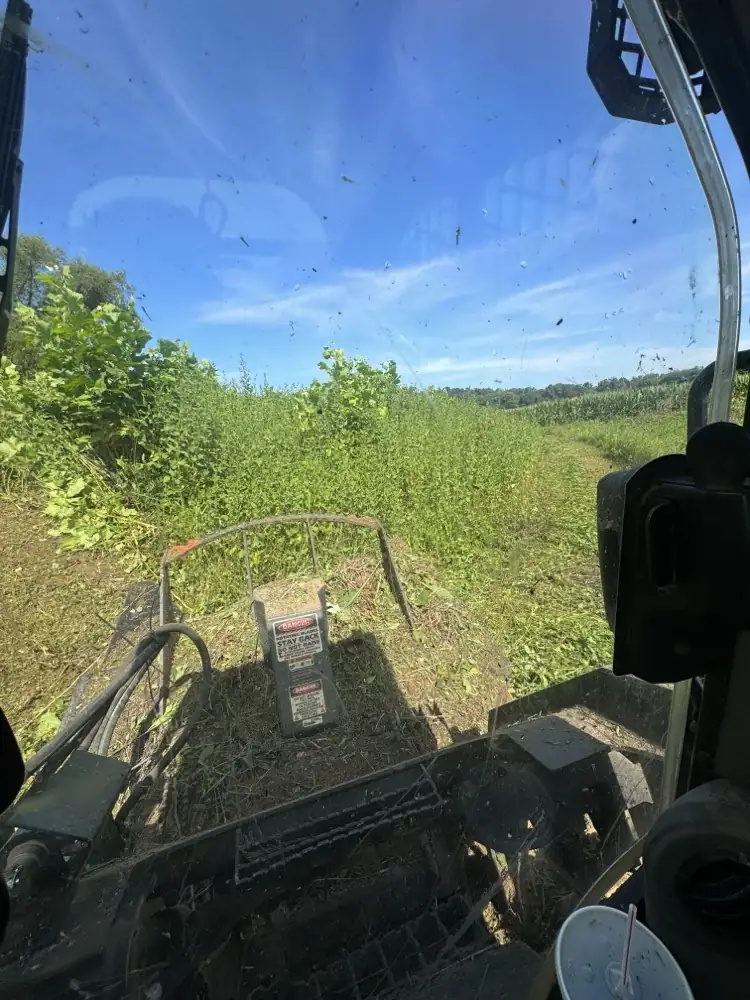
A skid steer with a mulcher head grinds standing brush, saplings, and undergrowth where they stand. The wood comes out the front as chips. Those chips stay on the ground as a layer of cover.
The material stays where it falls. Stumps and root systems stay down in the dirt. You end up with open ground that still has live roots under it.
Because the roots are alive, sprouts come back. Mulched fence lines, trails, and pasture edges want another pass down the road to stay open.
National guides price mulching by stem size, from material under 4 inches up to 10 to 16 inches and larger. Big hardwoods push the price to the top of the range.
What does traditional land clearing leave behind?
Land clearing pushes the trees and brush out and pulls the stumps. An excavator with a thumb grabs each stump and lifts the root ball out. What is left is bare dirt you can dig, cut, and fill.
The debris has to go somewhere. It gets burned on site or hauled off, and both cost money. National cost guides put on-site burning at $200 to $800 per acre. They put haul-off at $500 to $2,000 and up per acre.
Bare dirt also washes. Middle Tennessee gets around 50 inches of rain a year. Our clay holds water instead of soaking it in, so a cleared slope moves soil in the first hard storm.
How do the published costs compare?
Here is how the ranges line up. The left column is a 2026 Tennessee state cost guide. The right column pulls from national home cost guides.
| Work | Tennessee guide, per acre | National guides, per acre |
|---|---|---|
| Forestry mulching | $1,105 to $1,950 | $400 to $4,000, by stem size |
| Clearing light brush | $975 to $1,560 | $580 to $2,500 |
| Clearing medium brush and small trees | $1,430 to $2,210 | $2,000 to $3,500 |
| Clearing heavy forest | $2,080 to $3,250 | $3,300 to $6,155 |
| Pulling stumps and grubbing | $2,600 to $4,160 | $250 to $800 per stump |
| Burning debris on site | not listed | $200 to $800 |
| Hauling debris off | not listed | $500 to $2,000 and up |
Two national guides put the average clearing job around $2,581 and $2,900 per acre. One national guide puts the Southeast 10 to 20 percent under national averages. The same guide says jobs over 5 acres price better per acre, by 10 to 20 percent. Again, these are market numbers, not our price list.
Which one fits a build site, and which fits pasture and trails?
If a footing, a slab, a driveway, or a septic field is going in, the roots have to come out. Stumps left under a pad rot out and leave soft spots. Fill settles into those spots later. Anything you dig into gets cleared first, then site prep and grading shapes the pad.
Mulching fits the jobs where you are not digging. Reclaiming grown-up pasture, opening fence lines, cutting trails, and thinning understory all suit a mulcher head.
Around Clarksville and Montgomery County, that split shows up all the time. Wooded lots along US 79 and the I-24 corridor toward Nashville get cleared for houses. Farm ground out in Robertson, Cheatham, and Stewart counties gets mulched back to pasture.
What happens with erosion and the mulch cover?
The chip layer is the quiet advantage of mulching. Cost guides note that the mulch stays on site and works as erosion cover. On a Middle Tennessee hillside, cover on the ground is worth a lot.
Clearing to bare dirt runs the other way. That ground needs erosion control measures like silt fence, rock check dams, seeding, and matting until something grows back.
Tennessee’s construction stormwater permit kicks in at one acre of soil disturbance. Smaller sites count too when they sit inside a larger plan of development. TDEC runs that program, and the permit names clearing and grubbing as soil disturbing work. Builders around Clarksville and Nashville deal with it on most subdivision lots.
Do you need a permit, and can you burn the debris?
Burning is the part people forget. The Tennessee Division of Forestry requires a burn permit from October 15 through May 15 for debris pile fires. You can get one at BurnSafeTN.org or by calling 877-350-BURN.
The state also wants a firebreak 3 to 5 feet wide. Someone has to stay with the fire until it is out. Cities and counties add their own open burning rules, so check locally before you light a pile.
Mulching leaves the material on the ground as chips. With no burn pile, the burn permit season stops driving your schedule.
How fast is each one?
National guides put mulching at roughly 0.5 to 2 acres per day, depending on how thick the growth is. It is one machine making one pass.
Clearing runs in stages. Trees come down, stumps come out, debris gets piled, then it burns or gets hauled, then the ground gets graded. Each stage is its own day or days.
Wet weather changes both. Clay on the Highland Rim turns to mud and slows equipment after a hard rain.
So which one should you pick?
Building something? Clear it. Opening ground you want to keep open? Mulch it. Plenty of properties get both, with the build area cleared and the back acreage mulched.
If you are not sure which side your project falls on, we can come look at the ground with you. See what forestry mulching involves, or call or text (931) 572-8673 for a free estimate.