
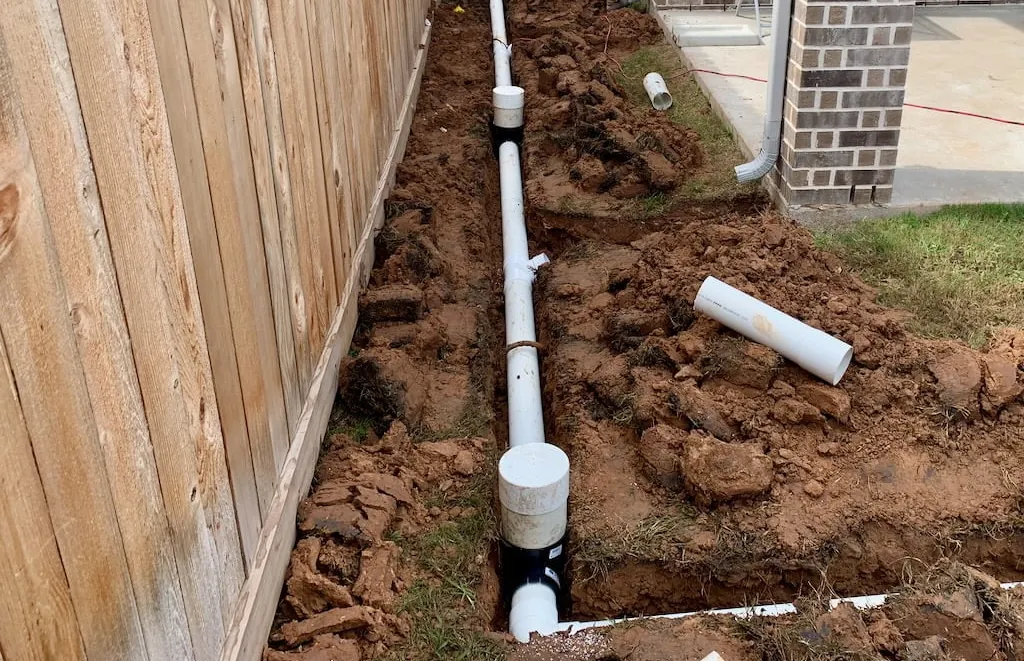
How Much Does a French Drain Cost in Tennessee in 2026?
Published cost guides put French drain work at about $10 to $100 per linear foot installed. A shallow yard drain sits near the bottom of that range. A deep drain at a foundation footing sits at the top. One national guide puts that at $80 to $100 per foot. Whole projects run about $1,650 to $12,250, with $5,000 listed as the national average.
Those are market numbers from national cost guides, not our price list. What a wet yard costs near Clarksville or Nashville comes down to length, depth, and digging conditions. Middle Tennessee clay makes that last one matter more here than in most places.
What does a French drain cost per linear foot?
Here is what the 2026 national cost guides publish. Every figure is installed cost, per linear foot of drain.
| Where the drain goes | Published cost per linear foot |
|---|---|
| Curtain drain across a slope | $10 to $25 |
| Shallow yard drain | $20 to $40 |
| Exterior drain, general range | $10 to $65 |
| Along a driveway | $45 to $55 |
| Around the outside of a house | $50 to $80 |
| Foundation or footing drain | $80 to $100 |
| Interior basement drain | $40 to $100 |
Length turns a per foot price into a project number. One guide prices an exterior run at $500 to $3,250 for 50 feet. It puts 100 feet at $1,000 to $6,500, and 200 feet at $2,000 to $13,000.
Why does depth change the price so much?
Depth is hours. A yard drain goes about 18 to 24 inches below the wet ground, by one guide’s standard. That is a quick trench for an excavator on open ground.
A foundation drain is a different job. It has to reach the footing, several feet down. The residential code calls for drains around foundations that hold back earth and enclose usable space below grade. The gravel has to run a foot past the outside edge of the footing. It also sits six inches above the footing.
Cost guides show that split in the labor line. Outside labor runs about $20 to $25 per linear foot. Inside basement labor runs $35 to $40, and hourly rates land between $35 and $100 per worker.
Why does water stand around foundations in Middle Tennessee?
Two things stack up here. Middle Tennessee gets roughly 50 inches of rain a year. Under the topsoil sits clay, and clay holds water instead of passing it through.
Water that cannot soak down moves sideways. It follows the loose backfill next to the foundation, because that dirt is softer than the ground around it. That is why the wet spot shows up against the house first.
Limestone close to the surface adds to it across the Highland Rim and parts of Montgomery County. Water runs along the top of rock the same way it runs along clay. Days after a storm the yard is still soft, and the low corner is still holding water.
When does regrading fix it instead of a drain?
Sometimes the drain is the wrong tool. If the ground falls toward the house, the yard is delivering water to the foundation. Changing the elevation fixes that at the source.
Regrading moves dirt so water sheds away from the wall and runs out to a low point. On a lot with room to work, that is often less work than a deep drain. Grading and dirt work also takes out the low spot that holds water after every rain.
A drain earns its keep when the grade is already right and water still shows up. Long slopes above a house do that, and so does heavy clay. Plenty of yards get both: cut the grade first, then drain what the grade cannot move.
What drives the price on a Tennessee lot?
Digging conditions come first. National guides note that heavy clay and rocky soil slow the work down, and labor is billed by the hour. Rock near the surface can stop a trench cold and change the route.
Access is next. A machine that can reach the wet side of the house works fast. A tight side yard or a fenced back yard turns the same footage into slow work.
Where the water goes is the third one. A drain needs an outlet lower than the pipe. Guides call for at least one inch of fall every eight feet. No low ground nearby means a longer run to reach it.
Putting the yard back matters too. Guides list landscape work at $50 to $100 per hour and sprinkler repair at $132 to $406. Add permits at roughly $50 to $100 where a community requires one for excavation.
What about slopes and driveways?
A slope above the house is its own problem. Bare dirt on a grade moves in a hard rain. Silt then fills a drain that worked fine last spring. Erosion control measures hold the soil so the drain keeps carrying water.
Driveways are the other one. Guides price a drain along a drive at $45 to $55 per foot. Crossing a drive means cutting it and putting it back. A gravel driveway that washes out usually needs a crown and ditches first, before anyone buries pipe.
What is not included in a per foot price?
A per foot number covers the trench, the pipe, the gravel, and the fabric. It usually leaves out the outlet, the surface inlets, and the yard repair after. One guide prices a catch basin system at $2,500 to $5,000. It puts a dry well at $1,500 to $5,000.
Interior work is a different trade. An inside basement drain is a waterproofing job, and guides put it at $40 to $100 per foot. Outside work is the grade, the trench, and the pipe that carries water away from the house.
Ask any bidder what the number includes before you compare two of them. Two quotes for the same yard can cover very different scopes.
How do you get a real number for your yard?
Every range on this page is a starting point. A wet yard prices out after someone stands in it and sees where the water comes from. Length and depth get set by the ground, not by a calculator.
We do French drain and yard drainage work around Clarksville, out toward Nashville, and across Middle Tennessee. We are based in Woodlawn, just west of Clarksville. Estimates are free, so call or text (931) 572-8673 and we will come look at the water.