How Much Does Bush Hogging Cost Per Acre in Tennessee?
Bush hogging runs about $75 to $250 per acre in published 2026 cost guides, with the average near $150. Open, maintained pasture sits at the low end. A field that got away, with waist-high growth and briars, prices toward the top. Small lots often go for a flat rate instead.
By the hour, the same guides put the machine at $60 to $120 and the machine plus labor at $90 to $180. Most companies also hold a minimum charge of $150 to $350 per visit. That minimum pays for hauling equipment out to the field and back.
What does bush hogging cost per acre in 2026?
A national 2026 cost guide prices bush hogging at $75 per acre on the low end, $150 as the average, and $250 on the high end. A Southeast operator’s posted rate table lands in the same band. It sorts the price by how tall the growth is. Bush hogging a field that got away costs more than cutting ground that gets a pass every year.
These are market numbers from published guides and posted rate tables. They are not our price list.
| Line item | Published range | Kind of source |
|---|---|---|
| Bush hogging, per acre | $75 to $250, average near $150 | national cost guide |
| Flat, maintained field | $50 to $75 per acre | Southeast operator rate table |
| Waist-high growth | $75 to $150 per acre | Southeast operator rate table |
| Chest-high growth with saplings | $150 to $250 per acre | Southeast operator rate table |
| Lot under one acre | $150 to $350 flat | Southeast operator rate table |
| Per hour, machine only | $60 to $120 | national cost guide |
| Per hour, machine plus labor | $90 to $180 | national cost guide |
| Minimum charge per visit | $150 to $350 | national cost guide |
| Travel | $0.50 to $3.00 per mile or per trip | national cost guide |
| Five to ten acres, total | $750 to $2,000 | national cost guide |
| Twenty acres, total | $1,400 to $4,000 | national cost guide |
| Repeat service discount | 15 to 20 percent | Southeast operator rate table |
Two lines in that table do most of the work. The per-acre rate tells you the shape of the job. The minimum tells you what a half-acre corner will still cost.
What makes one field cost more than another?
Condition moves the price more than acreage does. Height and density come first, then the ground itself, then whatever is hidden in the grass. Cost guides note that rough terrain, slopes, rocks, and debris push a job toward the top of the published range. Access counts too, since a gate the machine cannot fit through changes the plan.
- Height and density. Knee-high grass cuts fast. Chest-high growth laced with briars takes longer and sometimes more than one pass.
- Seasons since the last cut. One season is still a mowing job. Two or three seasons and woody stems come in.
- Terrain and slope. A steep bank gets cut slower and in a different direction than flat ground.
- Rock and stumps. Limestone sits close to the surface across the Highland Rim. Hidden rock and old stumps break blades, so a cutter runs higher and slower.
- Access. Narrow gates, soft entrances, and fenced corners all add time.
- Acreage. Published rates drop per acre as the field gets bigger. Ten acres of the same growth prices lower per acre than one.
- Travel. Guides list $0.50 to $3.00 per mile or per trip for getting equipment to the site.
When is forestry mulching worth the higher price?
Mulching costs more per acre than bush hogging, and it handles what a brush cutter cannot. One national cost guide puts forestry mulching at $150 to $250 per hour, or about $400 per acre on average. A 2026 clearing guide prices medium to heavy brush mulching at $1,500 to $4,500 per acre. The gap between those two figures is stem size.
A brush cutter knocks down grass, weeds, briars, and saplings a couple of inches through. Past that, stems bend under the deck and stand right back up. Grinding brush and saplings in place leaves chips on the ground and opens the field in one operation. A field left three or four seasons usually takes the mulcher first. A bush hog after that holds it open.
The same clearing guide puts medium brush work in the Southeast at $1,200 to $3,200 per acre. That is the band a neglected field falls into once the growth turns woody.
When is the job land clearing instead?
Once there is standing timber and stumps, the job has moved from mowing to clearing. A national cost guide prices lightly forested land at $733 to $2,333 per acre and heavily forested land at $3,395 to $6,155 per acre. Stump removal in that same guide averages $326, plus $40 to $83 for each stump after the first.
Clearing a lot down to open ground takes out the trees and pulls the stumps. What is left can be built on or planted. A brush cutter cannot fix a field that grew into woods.
What takes over an idle field in Middle Tennessee?
An old field around Clarksville fills in fast. Tall fescue and johnsongrass shoot up and go to seed. Broomsedge takes the thin spots. Blackberry briars run in from the fence rows, and cedar and sweetgum seedlings follow them. Privet and bush honeysuckle push in along the edges.
Middle Tennessee gets roughly 50 inches of rain a year, so growth comes back quickly. Highland Rim clay holds water and turns soft after a wet week. Limestone sits close to the surface in places across Montgomery County. Hidden rock is a real cost driver on this ground.
That is also why the price of a field changes so much year to year. One season of growth is a mowing job. Three seasons and the tool changes, and so does the number.
When should a field get cut around Clarksville?
Late summer and the dormant season are the two good windows here. Late summer lets ground-nesting birds finish in the grass. The dormant season gives firm ground and growth that has died back. That cuts faster and is easier on equipment.
Wet spring ground is the worst time. A heavy machine on soft clay leaves ruts that hold water the rest of the year. Fields kept on a schedule also cost less each visit. One Southeast operator’s posted rates give 15 to 20 percent off for repeat service.
Getting a real number for your field
Published ranges show you the shape of the cost. They cannot tell you what your field will take. That comes from the acreage, the height of the growth, the slope, and whatever is hidden in the grass.
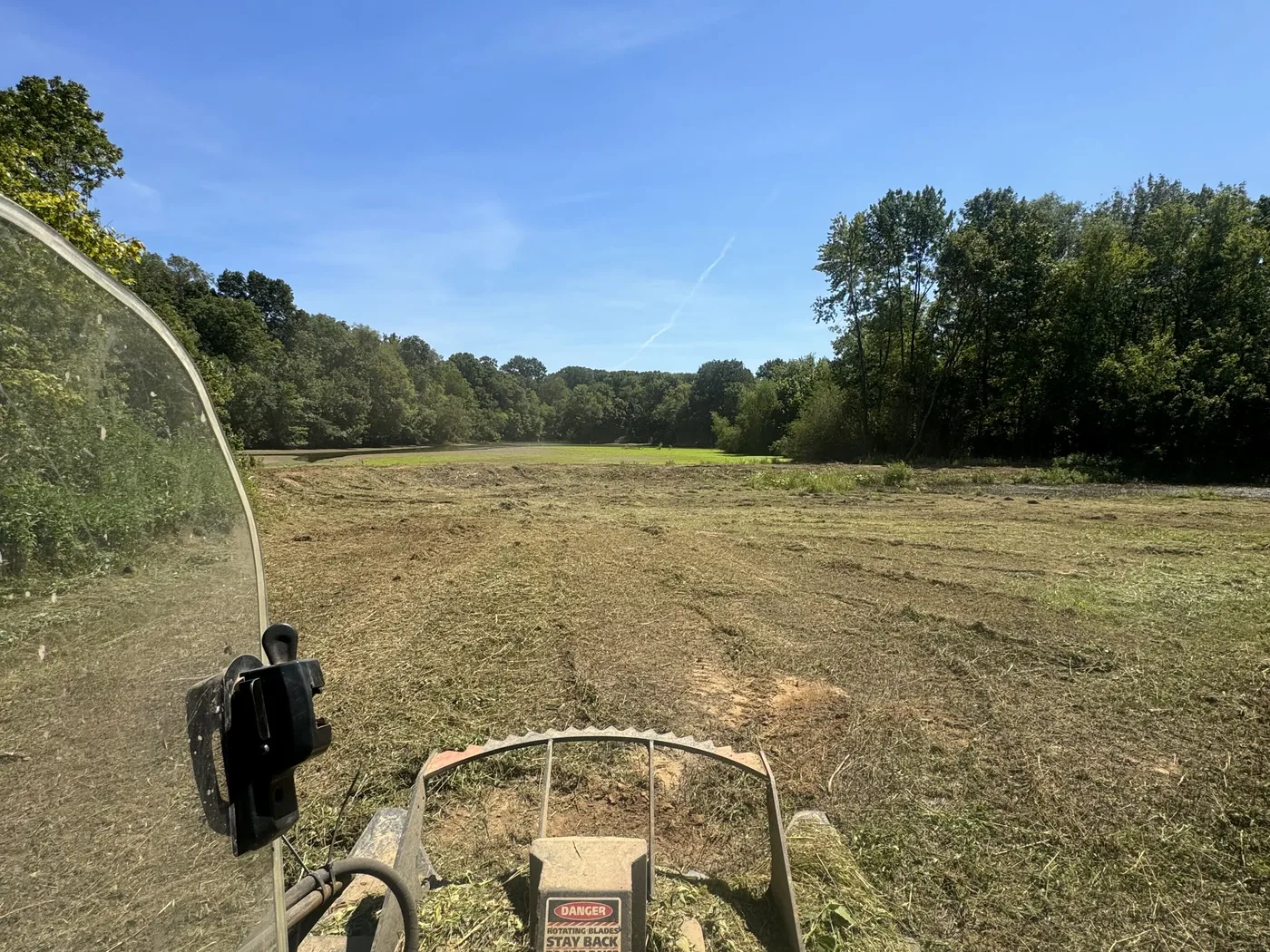
We handle field and pasture mowing with a brush cutter out of Woodlawn, just west of Clarksville. We cover Montgomery County and travel on toward Nashville. Estimates are free and we come look at the ground. Call or text (931) 572-8673.